Guide · updated 10 November 2026
Car battery voltage chart: what 12.2, 12.4 and 12.6 V mean
A rested 12 V car battery reads about 12.60 V when it is full. Every tenth of a volt below that is a large step in charge, so the reading is only worth something when you take it the right way: engine off, battery rested, meter on DC volts. This page has the chart for flooded and AGM batteries, what each value means, and the range to expect with the engine running.
iPhone and iPad (iOS 17 or later): free on the App Store. Android later.
The chart: a 12 V battery at rest
| Verdict | Car battery 12 V (flooded) | 12 V AGM |
|---|---|---|
| FULL | 12.60 and up | 12.80 and up |
| GOOD | 12.40 to 12.60 | 12.50 to 12.80 |
| WEAK | 12.20 to 12.40 | 12.20 to 12.50 |
| Below Weak | 12.00 to 12.20CHARGE & RETEST | 12.00 to 12.20CHARGE & RETEST |
| Lower still | under 12.00REPLACE | under 12.00REPLACE |
Measured at rest, with nothing connected. A reading exactly on a boundary counts as the higher band.
Flooded is the common starter battery with liquid acid. An AGM battery rests higher: it is full at 12.80 V, against 12.60 V for a flooded one. The label on the battery says which one you have. A 12 V motorcycle battery uses the same chart, flooded or AGM as its label says.
What the reading means
For a flooded battery that has rested:
| Resting voltage | State of charge | What to do |
|---|---|---|
| 12.60 V or more | about 100 % | Nothing. It is full. |
| 12.40 V | about 75 % | Usable. Charge it when you can. |
| 12.20 V | about 50 % | Charge it soon. |
| 12.00 to 12.20 V | low | Charge it fully, let it rest, then measure again. |
| under 12.00 V | very low | Charge it fully and let it rest. Still under 12.00 V: replace it. |
The percentages follow Battery University's table for lead-acid batteries at rest. They are a guide, not a gauge: two batteries at the same voltage can differ in age and in strength.
Let it rest first: surface charge
Right after driving or charging, a battery carries a surface charge and reads high. That reading says nothing about its real state of charge. Do one of these before you measure:
- Let the battery rest for 4 hours or more with the engine off.
- Or switch the headlights on for 1 minute, switch them off, and then measure.
A reading above 13.50 V with the engine off is not a resting voltage at all: a charger is still connected, or the surface charge is still there.
How to measure it
- Switch off the engine and everything electrical. Let the battery rest, or use the headlights as described above.
- Set the multimeter to DC volts. On a meter without auto-range, pick the 20 V range.
- Touch the red probe to the plus terminal and the black probe to the minus terminal. Probe the metal posts themselves, not a bolt or a corroded clamp.
- Hold the probes still and read the voltage with two decimals. One decimal is too coarse: the bands are only two tenths of a volt apart.
Never put the meter on a current (A) range across the battery, and keep metal tools away from the two terminals. A car battery can deliver hundreds of amps into a short.
With the engine running
With the engine running you measure the charging system, not the battery. A typical reading is 13.8 to 14.7 V. Many newer cars control the alternator from the engine computer, and their voltage can sit lower or higher for a while without any fault. Treat the range as typical, not as a limit. A reading that stays at the resting voltage with the engine running means the battery is not being charged.
6 V and 24 V batteries
The chart scales with the number of cells. A 6 V battery has half the cells of a 12 V one, so halve every value: it is full at 6.30 V. A 24 V system is two 12 V batteries in series, so double every value: it is full at 25.20 V. In a 24 V system, also measure each 12 V battery on its own: one weak battery hides behind a good one.
What a resting voltage cannot tell you
A resting voltage shows how charged the battery is. It does not show whether the battery can still crank the engine: a battery with a weak cell can rest at a good voltage and collapse under the starter's load. That takes a load test. If the battery reads GOOD after a night's rest and the engine still turns slowly, have the battery load-tested.
The shortcut in the app
Coming Coming in an app update. It is not in the app you can install today.
The battery tester in TestNMeasure reads the voltage live from a Bluetooth multimeter and shows the verdict for a flooded or an AGM battery: FULL, GOOD, WEAK, CHARGE & RETEST or REPLACE, with the next step and the reminder to let the battery rest. It uses the bands of the chart on this page. More: Battery tester.
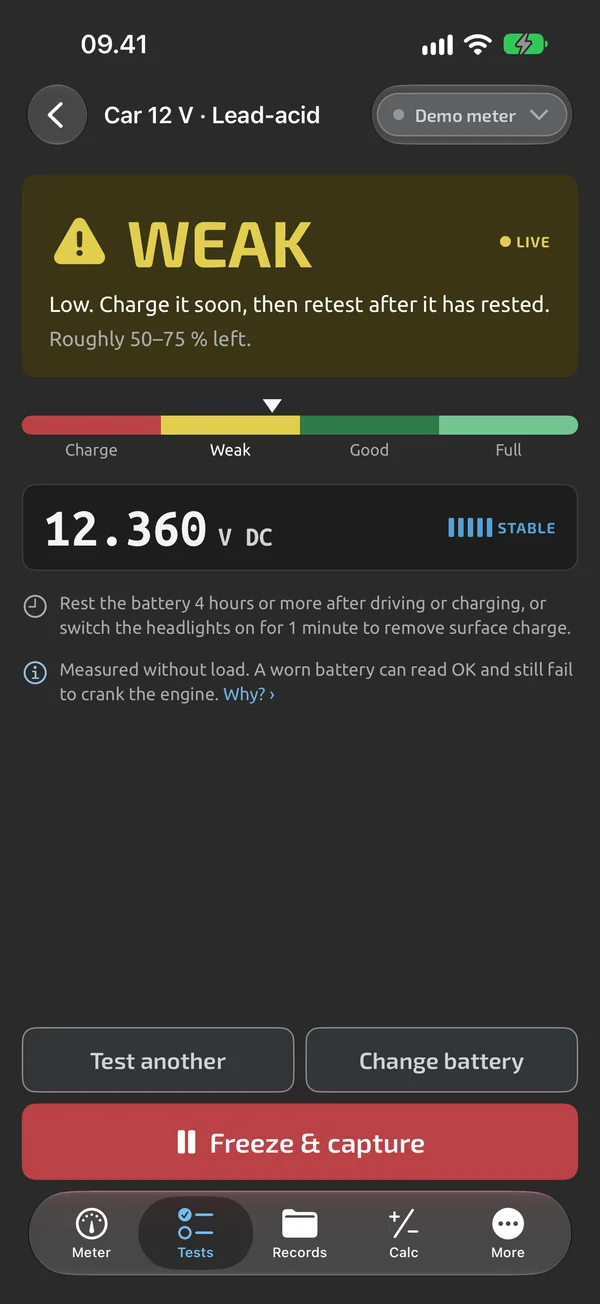
The app you can install today already shows the meter's reading large on your phone, which helps when the battery sits deep in the engine bay, with five stability bars that light when the reading is steady. One tap saves the reading with a label and a note, such as the car and the date of the last charge.
Where the numbers come from
The bands and the state-of-charge values follow Battery University (BU-903) and battery makers' charts, and they are the bands the app uses. The engine-running range is a typical value from workshop practice, not a limit from this chart. You can also type a reading into the battery checker, or start from the general guide: how to test a battery with a multimeter.
What the app does here, and what it doesn't
| What it does | Plan |
|---|---|
| Pick the battery type and see FULL, GOOD, WEAK or the end of its life from the DC volts, with the next step. | Free Coming |
| A large readout that shows which digits have settled; OL and UL are shown as OL and UL, never as a number. | Free |
| Five stability bars show when a reading is steady. | Free |
| One tap saves the current reading, with an Undo. | Free |
| Add a text note and a short label to any capture. | Free |
Not yet, or not planned
- No load test: the battery tester reads the voltage without load, so it cannot show a car battery's cranking strength.
- Reads what your meter measures; it doesn't change the meter's accuracy or ranges.
Questions
What should a 12 volt battery read on a multimeter?
At rest, a full flooded battery reads 12.60 V or a little more, and a full AGM battery 12.80 V or more. With the engine running the reading is typically 13.8 to 14.7 V, because you then measure the charging system.
Is 12.2 volts okay for a car battery?
It is about half charged. For a flooded battery, 12.20 V is the bottom of the WEAK band, so charge it soon. If it is back at this value after a full charge and a night's rest, the battery is worn or something in the car is draining it.
What is a normal voltage for a car battery?
At rest, 12.40 to 12.70 V for a flooded battery, which is about 75 to 100 % charged. With the engine running, typically 13.8 to 14.7 V.
Is 14.2 battery voltage good?
With the engine running, yes: it is inside the typical charging range of 13.8 to 14.7 V. With the engine off it is not a resting value. Anything above 13.50 V means a charger is connected or the surface charge is still there, so let the battery rest and measure again.
What voltage is too low on a car battery?
At rest, under 12.20 V a flooded battery is less than half charged: charge it fully and measure again after it has rested. If it is still under 12.00 V after a full charge, replace it.
What voltage is 50% of a 12V battery?
About 12.20 V at rest for a flooded lead-acid battery. About 12.40 V is 75 % and 12.60 V is 100 %.
Try it in the demo
A simulation of the app in your browser, with made-up readings: no meter and no install needed.
Get TestNMeasure for iPhone and iPad.
iPhone and iPad (iOS 17 or later): free on the App Store. Android later.


Questions or a meter to suggest? Mail support@testnmeasure.app.
No ad networks, no sign-up.