Guide · updated 12 November 2026
How to measure a battery's internal resistance with a multimeter
A worn battery can show a healthy voltage at rest and still fail in a device. The reason is its internal resistance: as a battery ages, the resistance inside it rises, and its voltage drops as soon as current flows. A reading under a known load shows it. You need a multimeter, one resistor, two voltage readings and one line of arithmetic.
iPhone and iPad (iOS 17 or later): free on the App Store. Android later.
What you need
- A multimeter with DC volts and ohms.
- The load resistor for your battery (see the table), rated for the power it has to take.
- Two clip leads, so the resistor stays on while the probes touch the battery.
Never short-circuit a battery, least of all a lithium one. Connect only the resistor named here, and only for the time shown. The resistor gets hot: put it on something that does not burn. Do not test a cell that is swollen, leaking or damaged. Do not try this on a 12 V car battery: it would take a load of 100 A or more. For a car battery the starter is the load.
The method
- Measure the resistor. Set the meter to ohms, hold the probe tips together and press REL so the leads read zero. Then measure the resistor through the clip leads you will use on the battery. Call the value R.
- Measure the battery at rest. DC volts, probes on the battery terminals, nothing connected. Call it V rest. Charge a rechargeable cell and let it rest first: a NiMH AA should read at least 1.28 V and an 18650 at least 3.80 V. A half-empty cell sags for that reason alone.
- Measure it under load. Clip the resistor across the battery and keep the probes on the battery's own terminals, not on the resistor or its clips. Read the voltage 2 seconds after the resistor goes on, then unclip one side. Call it V load. Lithium primary cells (coin cells, lithium AA and AAA, CR123A) can dip when the load goes on and recover over the next seconds: read them after 10 seconds.
- Calculate. The current is I = V load / R. The internal resistance is Ri = (V rest − V load) / I.
Probing at the terminals keeps the drop in the clip leads out of V load, and measuring R through the same leads keeps them in the current. If the voltage does not drop at all, the resistor is not connected: a reading without a drop says nothing about the battery.
A worked example
An alkaline AA rests at 1.50 V, which is GOOD at rest (from 1.45 V). With a 10 Ω resistor it reads 1.40 V after 2 seconds.
- Current: 1.40 / 10 = 0.14 A.
- Internal resistance: (1.50 − 1.40) / 0.14 = 0.71 Ω.
Under load the cell holds 1.40 V, above the 1.30 V line: GOOD under load. The 0.71 Ω is no alarm. Datasheets give 0.15 to 0.30 Ω for a fresh alkaline AA, measured with a pulse of a tenth of a second; after 2 seconds the result comes out higher. That is why an alkaline cell is judged by its voltage under load, and its internal resistance is for information.
Which load to use
| Battery | Resistor | Range that works | Rating, at least | Read at, off by |
|---|---|---|---|---|
| AA, AAA, C, D alkaline | 10 Ω | 8.2 to 12 Ω | 0.5 W | 2 s, 10 s |
| AA NiMH | 3.9 Ω | 2.2 to 4.7 Ω | 1 W | 2 s, 10 s |
| AAA NiMH | 3.9 Ω | 2.2 to 10 Ω | 1 W | 2 s, 10 s |
| 18650, 21700 Li-ion | 10 Ω | 3.9 to 22 Ω | 2 W | 2 s, 5 s |
| 9V alkaline | 330 Ω | 270 to 680 Ω | 0.5 W | 2 s, 10 s |
| LR44, SR44 | 330 Ω | 150 Ω to 1 kΩ | 0.25 W | 2 s, 10 s |
| CR2032, CR2025, CR2016, CR2450 | 1 kΩ | 390 Ω to 1 kΩ | 0.25 W | 10 s, 30 s |
| Lithium AA, AAA | 10 Ω | 3.9 to 12 Ω | 0.5 W | 10 s, 30 s |
| CR123A | 10 Ω | 3.9 to 100 Ω | 2 W | 10 s, 30 s |
A smaller resistor draws more current than the battery should give; a larger one is too light a load to show anything. A NiMH AA needs the 3.9 Ω: its voltage drops only about 13 mV under it, and a lighter load drops less than a meter resolves well. The power in the resistor is P = V rest × V rest / R; the ratings cover the highest resting voltage of each type for these few seconds.
What the result means
Internal resistance has no pass mark that fits every battery. These are the limits the app uses, for room temperature (about 20 °C). All of them are indicative: none has been checked with this two-second method on a bench yet.
| Battery | Judged on | GOOD | WEAK |
|---|---|---|---|
| AA, AAA, C, D alkaline | voltage under load | from 1.30 V | from 1.10 V |
| AA NiMH | internal resistance | up to 0.05 Ω | up to 0.10 Ω |
| AAA NiMH | internal resistance | up to 0.15 Ω | up to 0.30 Ω |
| 18650, 21700 Li-ion | internal resistance | up to 0.08 Ω | up to 0.16 Ω |
| CR2032, CR2025, CR2016, CR2450 | both | from 2.70 V and up to 40 Ω | from 2.50 V and up to 100 Ω |
Worse than WEAK means REPLACE, for a rechargeable cell too: a charged cell that collapses under load is worn out, and recharging will not help. The verdict is the worst of three: the reading at rest, the voltage under load and the internal resistance.
The 9V, LR44, SR44, lithium AA and AAA and CR123A have no limit for a worn cell in our sources. Note their numbers and compare them with a new battery of the same type, measured with the same resistor. For lithium AA and AAA the formula does not work at all: their resting voltage is higher than the voltage that carries the current, so the result comes out too high. Compare their voltage under load with a new cell instead.
For reference, a fresh cell has about: NiMH AA 0.03 Ω and NiMH AAA 0.10 Ω, charged (datasheets); 18650 0.02 to 0.08 Ω and CR2032 10 to 40 Ω (indicative); LR44 5 to 15 Ω and SR44 3 to 10 Ω (datasheets, measured with a 40 Hz signal).
Cold raises the internal resistance: a battery tested at 0 °C can show about twice its value at 25 °C (indicative). Test at room temperature: a cold battery reads worse than it is.
In the app
The load test in TestNMeasure on iPhone and iPad walks through these steps with your Bluetooth multimeter and does the arithmetic. Pick the battery in the battery tester and tap Test under load. The first screen names the resistor, the range that works, its rating in watts and the seconds under load. The app takes the resistor's value from the meter on Ω, then the reading at rest. Clip the resistor on and the count starts by itself as the voltage drops. At the reading time the app takes the loaded voltage and says "Remove the resistor now", with a vibration.
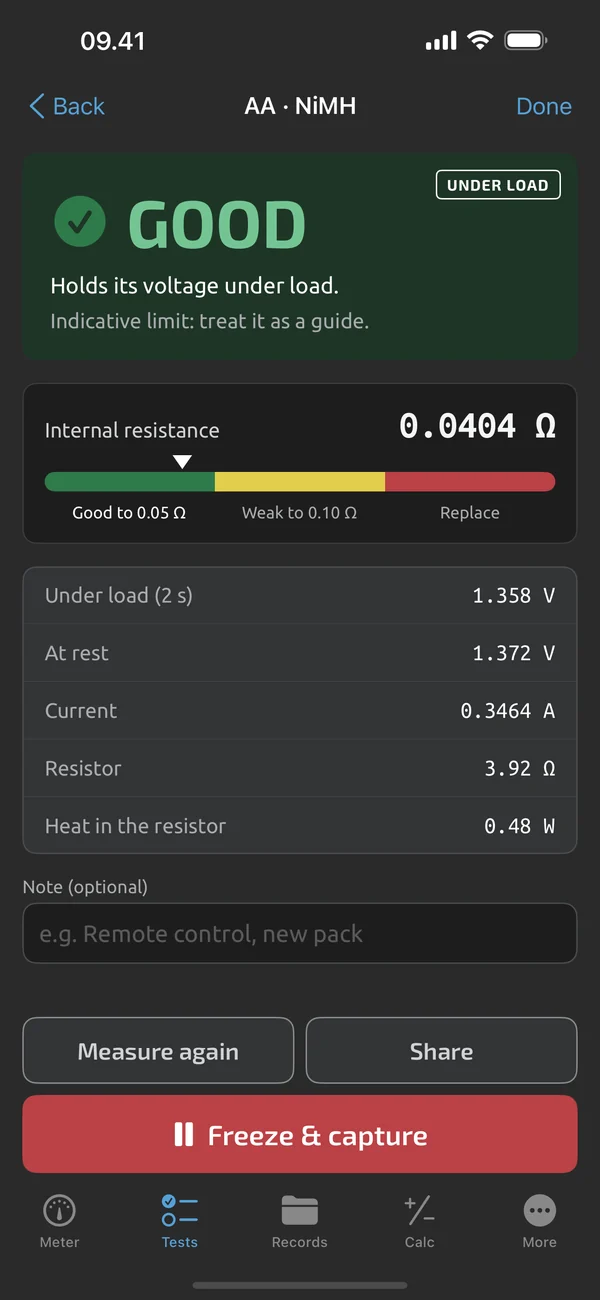
The result shows the voltage under load, the current, the internal resistance (not for lithium AA and AAA) and the heat in the resistor. For the batteries in the limits table it says GOOD, WEAK or REPLACE with an Under load badge, marked indicative. For the others it says MEASURED and shows the numbers.
The app refuses what would give a wrong or unsafe result: a resistor outside the range ("This resistor would draw too much current from this battery" or "This resistor is too large to load this battery", each with the value to use), a NiMH or Li-ion cell that is not charged ("Charge it first"), a resistor taken off before the reading ("Too short, try again") and a reading with no voltage drop. There is no load test for 12 V car and AGM batteries (the app points to its car battery and charging test), 12 V LiFePO4, 6 V lantern and zinc-air batteries, or for batteries you define yourself.
Freeze & capture saves the result with an optional note. It goes into the battery history with the date and the verdict, so a test of the same cell months later shows how it changed. More: Battery tester.
Where the numbers come from
The resistors, times and limits are the ones the app uses. The method follows battery makers' guidance: Energizer's alkaline handbook loads a single cell with about 10 Ω for one to two seconds, and 1.10 V under that load means about 20 % of its service is left. The 1.30 V line is our estimate between a fresh cell and that point. Renata's formula for coin cells is the one above. The fresh values come from Energizer datasheets (NiMH, LR44, SR44) and the handbook (alkaline). The coin-cell and Li-ion values come from several sources that do not agree closely, and the WEAK limits for NiMH and Li-ion are twice the fresh value, our own rule. That is why every limit here is marked indicative until it is checked on the bench. The resting bands are the battery tester's; you can also type a reading into the battery checker.
What the app does here, and what it doesn't
| What it does | Plan |
|---|---|
| Put a known resistor across the battery for a few seconds and judge the voltage under load and the internal resistance. | Free |
| Pick the battery type and see FULL, GOOD, WEAK or the end of its life from the DC volts, with the next step. | Free |
| Every battery result is kept with the battery, the date and the verdict, so you can see what was tested and how it changed. | Free |
| A guided test of a 12 V starter battery and its charging system: rest, cranking, charging and ripple, with a one-page report. | Free |
Not yet, or not planned
- Reads what your meter measures; it doesn't change the meter's accuracy or ranges.
Questions
Can a multimeter measure internal resistance directly?
No. The ohms range sends its own small current and must never be used on a battery. You measure two voltages, at rest and under a known load, and calculate the resistance from the difference.
What is a good internal resistance for an AA battery?
For a NiMH AA, up to 0.05 Ω is GOOD (indicative); a fresh, charged cell has about 0.03 Ω. For an alkaline AA a two-second test gives more than the datasheet's 0.15 to 0.30 Ω, so judge it by its voltage under a 10 Ω load: from 1.30 V it is GOOD (indicative).
What is a good internal resistance for an 18650?
Up to 0.08 Ω is GOOD and up to 0.16 Ω WEAK (indicative); a fresh cell has about 0.02 to 0.08 Ω. Test it charged, with a 10 Ω resistor rated 2 W, read after 2 seconds and take the resistor off within 5 seconds.
Why does a battery read fine and still not work?
Because a multimeter reads it at rest. A worn battery has a high internal resistance, so its voltage drops when the device draws current. A reading under load shows it.
Try it in the demo
A simulation of the app in your browser, with made-up readings: no meter and no install needed.
Get TestNMeasure for iPhone and iPad.
iPhone and iPad (iOS 17 or later): free on the App Store. Android later.


Questions or a meter to suggest? Mail support@testnmeasure.app.
No ad networks, no sign-up.