Guide · updated 12 November 2026
How to test an alternator with a multimeter
You can test an alternator with a multimeter without removing it. Every reading is taken at the battery posts: one with the engine off and the battery at rest, two on DC volts with the engine running (loads off, then loads on), and one on AC volts for the ripple. Together they show whether the alternator charges and whether its diodes are healthy.
iPhone and iPad (iOS 17 or later): free on the App Store. Android later.
What you need
- A multimeter with DC volts and AC volts.
- Test leads with clips, so your hands stay out of the engine bay while it runs.
Keep hands, leads and clothing away from the fan and the belts. Clip the leads on before you start the engine, and connect and remove them with the engine off. A lead-acid battery can give off gas that burns: no sparks or flames near it. Never disconnect the battery while the engine runs to "test" the alternator: the voltage spike can damage the car's electronics.
Step 1: the baseline with the engine off
Set the meter to DC volts and measure across the battery posts with the engine and all loads off. A charged flooded battery at rest reads 12.40 to 12.70 V. Note the value: the charging reading has to be clearly higher.
Right after a drive the battery carries a surface charge and reads high. Switch the headlights on for 1 minute, then off, and measure again; or let the battery rest 4 hours. If the battery is under 12.20 V, charge it first, because an alternator test on a flat battery misleads. More: car battery voltage chart.
Step 2: charging voltage with the engine running
- Start the engine. Bring it to about 2000 rpm with all loads off and wait for a stable reading on DC volts.
- Keep it at about 2000 rpm, switch on the headlights and the blower, and read the voltage again.
- Typically 13.8 to 14.7 V, in both readings: the alternator charges.
- Close to the engine-off value: no charge is arriving. Check the belt, the plug and the main cable before you blame the alternator.
- Under 13.8 V only with the loads on: the alternator does not keep up with the load.
- Above 14.7 V: outside the usual range. On a car with a smart alternator this can be normal; on an older car, have the regulator checked.
Many newer cars control the alternator from the engine computer (a smart alternator). It can sit near 12.5 V when the battery is full and go to 15 V or more while the car brakes. On such a car a reading outside 13.8 to 14.7 V can be normal: watch the reading over several minutes and with different loads before you conclude anything. The range itself is indicative (see below).
Step 3: ripple on AC volts
An alternator makes AC and its diodes turn it into DC. A failed diode or a stator fault leaves AC ripple on the battery voltage. With the engine at about 2000 rpm and the loads on, switch the meter to AC volts and measure across the battery posts.
- Under 0.05 V AC: fine.
- From 0.05 V up to 0.30 V AC: borderline. Check the connections and measure again.
- 0.30 V AC or more: ripple this high suggests a faulty diode or stator. Have the alternator checked.
The 0.30 V line is indicative. Many multimeters measure AC on top of DC poorly, one more reason to measure a borderline value again. These limits are for 12 V systems.
Reading the result
| Charging voltage | Ripple | What it points to |
|---|---|---|
| 13.8 to 14.7 V | Under 0.05 V | The alternator is fine. Look at the battery, or at a drain while the car is parked. |
| Low | Under 0.05 V | No or little charge: belt, wiring, regulator or alternator. On a smart alternator it can be normal. |
| High | Under 0.05 V | Outside the usual range: normal for a smart alternator at work; on an older car, have the regulator checked. |
| Any | 0.30 V or more | A faulty diode or stator in the alternator. |
In the app
The car battery & charging test in TestNMeasure walks through four stages with your Bluetooth multimeter, in this order: at rest, cranking, charging (loads off, then headlights and blower on) and ripple. At rest it shows the battery verdict (FULL, GOOD, WEAK, CHARGE & RETEST or REPLACE) with about how charged the battery is, and it says "Surface charge" when the reading is too high to be a rest value. Cranking shows the steady voltage while the starter turns, which judges the battery rather than the alternator (more in how to test a car battery). Charging waits for a stable reading and says OK, LOW or HIGH against the usual 13.8 to 14.7 V, adding that on a car with a smart alternator a value outside it can be normal; it never calls the alternator faulty from the charging voltage alone. Ripple, on AC volts, says OK, BORDERLINE or FAULT. You can skip any stage.
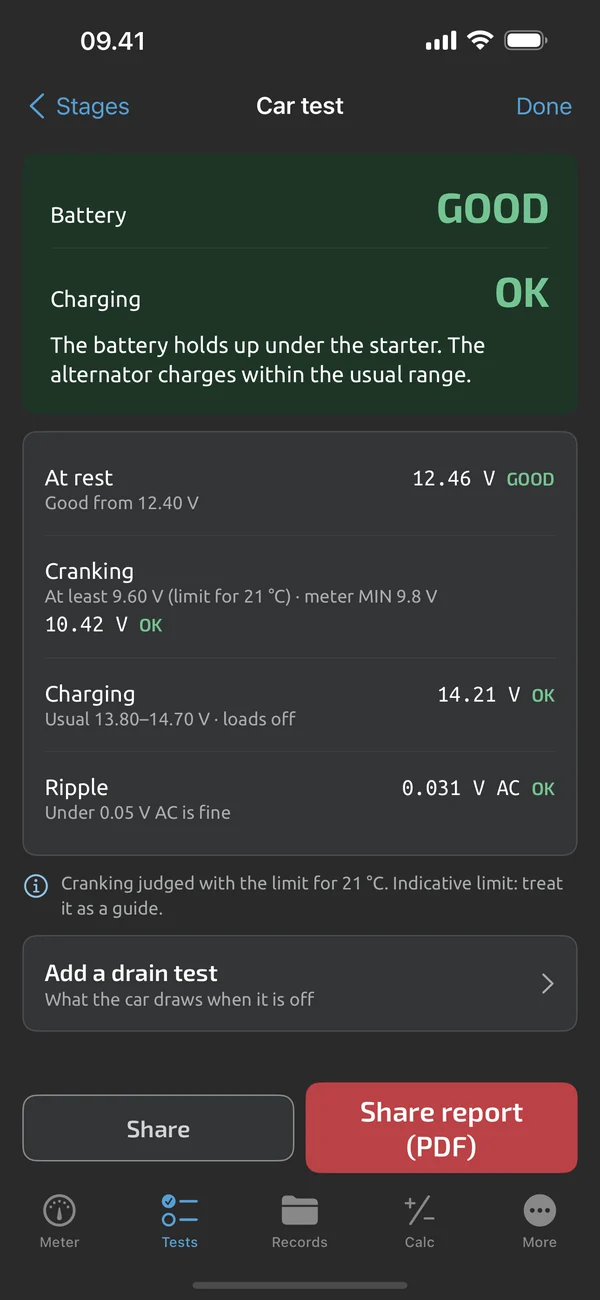
The summary has a Battery line and a Charging line, each with its colour and the next step in words, and "Share report (PDF)" makes a one-page report. Each finished stage is saved to Records, the stages linked as one result, and the test appears in your battery history, where you can test again later and compare the results. When the alternator is fine and the battery still goes flat, "Add a drain test" measures what the car draws while it is switched off. More: parasitic draw test.
For a smart alternator, a recording shows more than one reading. The app shows the running minimum, maximum and average and a live graph, and a recording keeps the voltage over a whole drive with a graph you can zoom afterwards.
Where the numbers come from
The charging range of 13.8 to 14.7 V is the usual workshop figure, also used in our 12 V battery and charging starter template; it is marked indicative in the app, because sources differ on loads on or off. The ripple limits follow Fluke's alternator guidance: under 0.05 V is good, 0.05 to 0.10 V is worth a second look, and 0.3 to 0.5 V or more points to a diode or stator fault. The app's fault line of 0.30 V is the low end of that range, so it is indicative. The resting values come from the same battery table as the car battery voltage chart. These are the limits the app uses. They are typical values, not limits from your car's maker: the workshop manual of the car wins.
What the app does here, and what it doesn't
| What it does | Plan |
|---|---|
| A guided test of a 12 V starter battery and its charging system: rest, cranking, charging and ripple, with a one-page report. | Free |
| Every battery result is kept with the battery, the date and the verdict, so you can see what was tested and how it changed. | Free |
| Log the current a switched-off car draws while its control units fall asleep, against the 50 mA line. | Free |
| Shows the running minimum, maximum and average since the last reset, with the sample count. | Free |
| Swipe the readout to a live graph with min and max lines, pan and zoom. | Free |
| Log sessions hold captures and time-series recordings, and recording continues with the screen locked. | Free |
| Review a session as a full graph with pan and zoom, statistics and its captures. | Free |
Not yet, or not planned
- Meter-side MIN/MAX modes show as flags only.
- Reads what your meter measures; it doesn't change the meter's accuracy or ranges.
Questions
How can I test my alternator without removing it?
Measure at the battery posts. With the engine at about 2000 rpm, a working alternator typically gives 13.8 to 14.7 V DC, with loads off and with the headlights and blower on. Then measure on AC volts: under 0.05 V of ripple is fine.
How to check if an alternator is charging the battery?
Compare two readings across the battery: engine off with the battery at rest, and engine running. If the second is clearly higher, typically 13.8 to 14.7 V, the alternator charges. If it stays at the engine-off value, it does not, unless a smart alternator has eased off because the battery is full.
How many volts is a bad alternator?
A reading that stays near the resting voltage of the battery with the engine running, about 12.60 V or less, means the alternator delivers little or no charge. A normal DC voltage with 0.30 V or more of AC ripple points to a faulty diode or stator.
What are the first signs of a bad alternator?
On the meter: a charging voltage that drops under 13.8 V when you switch on the headlights and blower, and ripple of 0.05 V AC or more. In the car: a battery that keeps going flat although it tests well after a charge.
Try it in the demo
A simulation of the app in your browser, with made-up readings: no meter and no install needed.
Get TestNMeasure for iPhone and iPad.
iPhone and iPad (iOS 17 or later): free on the App Store. Android later.


Questions or a meter to suggest? Mail support@testnmeasure.app.
No ad networks, no sign-up.