Test sequences
Nine starter templates to run as they are
The app includes nine starter templates, free and bundled, so a real test needs no setup. They are read-only: Use starts a run, and Customise, which is Pro, copies one to My templates. Each can be completed with the demo meter plus manual entry, and ST-1 auto-captures every pin with the demo.
iOS and Android, beta this winter.
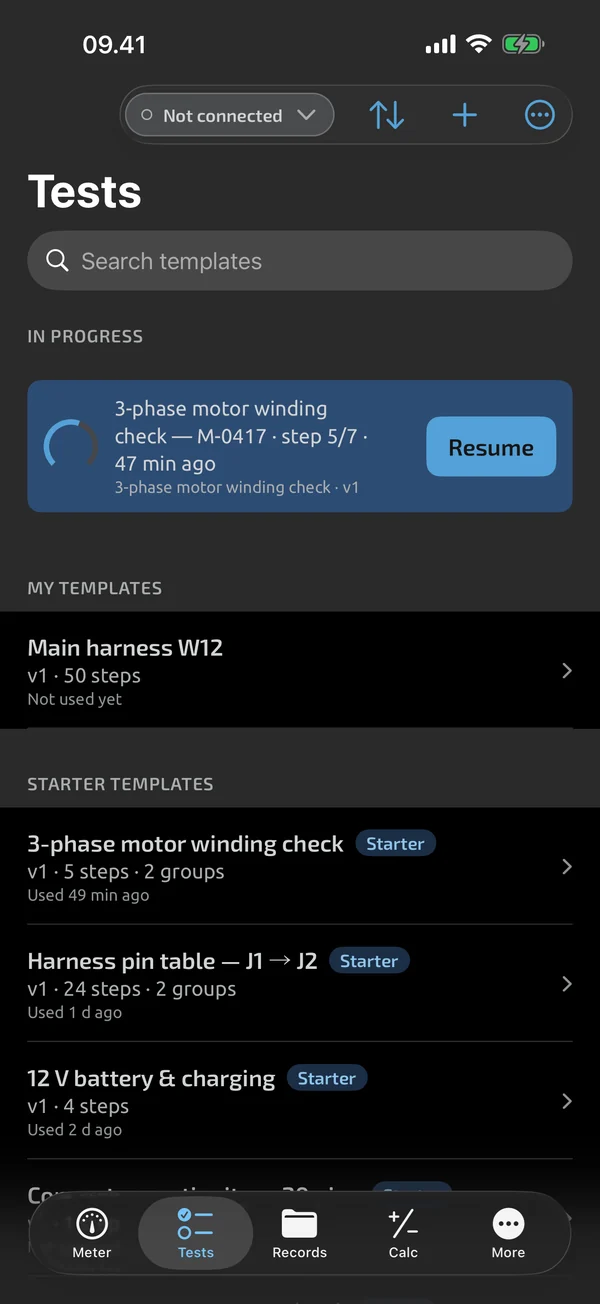
The nine templates
Connector continuity — 20 pins
ST-1 · 1 step, 20 positions
Continuity of 20 connector pins, one pin per position. Auto-captures each pin when the reading is steady; any pin above 1 Ω fails.
| # | Group | Label | Type | Expects | Limit | Capture | Required / skip |
|---|---|---|---|---|---|---|---|
| 1 | — | Connector pins ×20 (Pin 1 … Pin 20) | measure | Ω | max 1 Ω | inherit | req |
Harness pin table — J1 → J2
ST-2 · 24 steps, 24 positions
Point-to-point continuity J1 → J2 (12 conductors) and isolation of each J1 pin to the shell. Record the harness P/N, serial and build stage.
| # | Group | Label | Type | Expects | Limit | Capture | Required / skip |
|---|---|---|---|---|---|---|---|
| 1–12 | Cable 1 | J1-1 → J2-1 … J1-12 → J2-12 (×12) | measure | Ω | max 1 Ω | inherit | req |
| 13–24 | Cable 1 isolation | J1-1 → shell … J1-12 → shell (×12) | measure | Ω | expect_open (OL) | manual | req |
12 V battery & charging
ST-3 · 4 steps, 4 positions
Lead-acid 12 V starter battery: resting voltage, voltage while cranking, charging voltage with the engine running, and a terminal check.
| # | Group | Label | Type | Expects | Limit | Capture | Required / skip |
|---|---|---|---|---|---|---|---|
| 1 | — | Resting voltage | measure | V DC | range 12.4–12.9 V DC | inherit | req |
| 2 | — | Cranking voltage | measure | V DC | min 9.6 V DC | manual | req |
| 3 | — | Charging voltage | measure | V DC | range 13.8–14.7 V DC | inherit | req |
| 4 | — | Terminals clean and tight | check | Pass / Fail / N/A | none | — | req |
Li-ion pack cell voltages (14S)
ST-4 · 3 steps, 16 positions
14 series Li-ion cells measured at the balance connector, the spread between highest and lowest cell, and the pack voltage.
| # | Group | Label | Type | Expects | Limit | Capture | Required / skip |
|---|---|---|---|---|---|---|---|
| 1 | — | Cell ×14 (Cell 1 … Cell 14) | measure | V DC | range 3.00–4.20 V DC | inherit | req |
| 2 | — | Cell spread = `max(ch("Cell", 1..14)) - min(ch("Cell", 1..14))` | derived | V DC | max 0.05 V DC | — | req |
| 3 | — | Pack voltage | measure | V DC | range 42.0–58.8 V DC | inherit | req |
PCB power-rail bring-up
ST-5 · 5 steps, 5 positions
First power-up of a board: four supply rails against their tolerance, then a check that nothing is overheating.
| # | Group | Label | Type | Expects | Limit | Capture | Required / skip |
|---|---|---|---|---|---|---|---|
| 1 | — | Rail 3V3 | measure | V DC | 3.3 V DC ±5 % | inherit | req |
| 2 | — | Rail 5V0 | measure | V DC | 5.0 V DC ±5 % | inherit | req |
| 3 | — | Rail 1V8 | measure | V DC | 1.8 V DC ±3 % | inherit | req |
| 4 | — | Rail 12V | measure | V DC | 12 V DC ±10 % | inherit | req |
| 5 | — | No hot parts | check | Pass / Fail / N/A | none | — | req |
3-phase motor winding check
ST-6 · 5 steps, 7 positions
Winding resistance between the three phases, the imbalance between them, and a dead-short check of each phase to PE. Motor isolated and locked out.
| # | Group | Label | Type | Expects | Limit | Capture | Required / skip |
|---|---|---|---|---|---|---|---|
| 1–3 | Winding resistance | U-V … W-U (×3) | measure | Ω | none | inherit | req |
| 4 | Winding resistance | Imbalance = `(max(step("U-V"), step("V-W"), step("W-U")) - min(step("U-V"), step("V-W"), step("W-U"))) / avg(step("U-V"), step("V-W"), step("W-U")) * 100` | derived | % | max 5 % | — | req |
| 5 | Insulation to PE | Phase to PE ×3 (U-PE … W-PE) | measure | Ω | expect_open (OL) | manual | req |
Mains outlet check
ST-7 · 8 steps, 8 positions
QUALIFIED PERSONS ONLY — live mains. Voltage L-N, L-PE and N-PE at an outlet, plus polarity. Two variants: run the group for your mains and skip the other.
| # | Group | Label | Type | Expects | Limit | Capture | Required / skip |
|---|---|---|---|---|---|---|---|
| 1–2 | 230 V outlet | L-N (230 V) … L-PE (230 V) (×2) | measure | V AC | range 207–253 V AC | inherit | req, skip allowed |
| 3 | 230 V outlet | N-PE (230 V) | measure | V AC | max 2 V AC | inherit | req, skip allowed |
| 4 | 230 V outlet | Polarity correct (230 V) | check | Pass / Fail / N/A | none | — | req, skip allowed |
| 5–6 | 120 V outlet | L-N (120 V) … L-PE (120 V) (×2) | measure | V AC | range 108–132 V AC | inherit | req, skip allowed |
| 7 | 120 V outlet | N-PE (120 V) | measure | V AC | max 2 V AC | inherit | req, skip allowed |
| 8 | 120 V outlet | Polarity correct (120 V) | check | Pass / Fail / N/A | none | — | req, skip allowed |
Solar panel quick check
ST-8 · 7 steps, 7 positions
Open-circuit voltage and short-circuit current of one PV panel against its nameplate, with a note on the sun conditions.
| # | Group | Label | Type | Expects | Limit | Capture | Required / skip |
|---|---|---|---|---|---|---|---|
| 1 | Nameplate | Nameplate Voc | value | V DC | none | manual | req |
| 2 | Nameplate | Nameplate Isc | value | A DC | none | manual | req |
| 3 | Measured | Voc | measure | V DC | none | inherit | req |
| 4 | Measured | Isc | measure | A DC | none | manual | req |
| 5–6 | Measured | Voc vs nameplate = `(step("Voc") - step("Nameplate Voc")) / step("Nameplate Voc") * 100` … Isc vs nameplate = `(step("Isc") - step("Nameplate Isc")) / step("Nameplate Isc") * 100` (×2) | derived | % | range -10–10 % | — | req |
| 7 | Measured | Irradiance / conditions | value | text | none | manual | optional |
Quick 10-point log
ST-9 · 10 steps, 10 positions
Ten measurement points with no limits. Measure anything in order; each point records the reading as-is.
| # | Group | Label | Type | Expects | Limit | Capture | Required / skip |
|---|---|---|---|---|---|---|---|
| 1–10 | — | Point 1 … Point 10 (×10) | measure | any reading | none | inherit | req |
Starter templates are examples; check limits against your equipment's documentation.
What it does and doesn't do (yet)
| What it does | Plan |
|---|---|
| Starter templates for common tests are included in the app. | Free |
Not yet, or not planned
- Starter templates are examples (beta-v1, revisable); you set the limits for your equipment.
Questions
Can I change a starter template?
Starter templates are read-only. Customise copies one to My templates for you to edit, and editing is part of Pro.
Are the limits official?
No. They are examples. Starter templates are examples; check limits against your equipment's documentation, and set the limits for your own equipment.
Can I run them with the demo meter?
Yes. Each can be completed with the demo meter plus manual entry, and the first template, Connector continuity, auto-captures every pin with the demo. To try it, see Meters.
Coming to iPhone and Android.
iOS and Android, beta this winter.


Questions or a meter to suggest? Mail support@testnmeasure.app.
No ad networks, no sign-up.