Guide · updated 10 November 2026
How to test a battery with a multimeter
A multimeter can test almost any battery in a minute. Set it to DC volts, touch the red probe to plus and the black probe to minus, and read the voltage. The number only means something next to the right chart: a healthy rechargeable AA reads lower than a worn-out alkaline one. This guide has the steps, a chart for each battery family, and what a voltage reading cannot tell you.
iPhone and iPad (iOS 17 or later): free on the App Store. Android later.
What you need
- Any multimeter with a DC volts range. It needs no special battery range.
- The battery, out of its device.
- The battery's chemistry, from its label: alkaline, lithium, NiMH, Li-ion or lead-acid. The size alone is not enough.
Step by step
- Take the battery out of the device and let it rest for a minute. A car battery needs longer: see the car battery voltage chart.
- Put the black lead in the COM socket and the red lead in the socket marked V.
- Set the meter to DC volts: the V with a straight line, not the wave. On a meter without auto-range, pick the first range above the battery's voltage, for example 20 V for a 9 V or a 12 V battery.
- Touch the red probe to plus and the black probe to minus. Hold them still until the digits stop moving.
- Read the voltage. A minus sign means the probes are swapped. Nothing is damaged: swap them.
- Look the reading up in the chart for your battery below, or type it into the battery checker.
Measure volts only. Never put the meter on a current (A) range across a battery: that shorts the battery through the meter. Do not let a probe or a tool bridge the two terminals of a lithium or a car battery.
Battery voltage charts
Every chart shows the resting voltage: the battery out of its device, nothing connected, read after a short rest. Find your battery by its chemistry first, then by its size.
AA, AAA, C, D and 9 V alkaline
| Verdict | AA alkaline, AAA alkaline, C / D alkaline | 9V alkaline |
|---|---|---|
| FULL | 1.55 and up | 9.30 and up |
| GOOD | 1.45 to 1.55 | 8.70 to 9.30 |
| WEAK | 1.30 to 1.45 | 7.80 to 8.70 |
| Below Weak | under 1.30REPLACE | under 7.80REPLACE |
Measured at rest, with nothing connected. A reading exactly on a boundary counts as the higher band.
More on these: AA and AAA battery voltage, C and D battery voltage and 9V battery voltage.
Coin and button cells
| Verdict | CR2032, CR2025, CR2016, CR2450 | LR44 alkaline button | SR44 silver oxide indicative |
|---|---|---|---|
| FULL | 3.15 and up | 1.55 and up | 1.57 and up |
| GOOD | 3.00 to 3.15 | 1.45 to 1.55 | 1.53 to 1.57 |
| WEAK | 2.80 to 3.00 | 1.35 to 1.45 | 1.48 to 1.53 |
| Below Weak | under 2.80REPLACE | under 1.35REPLACE | under 1.48REPLACE |
Measured at rest, with nothing connected. A reading exactly on a boundary counts as the higher band. Indicative: few sources or a flat curve, so treat these bands as a guide.
Coin cells hold their voltage until they are nearly empty. Read the CR2032 and coin cell guide before you trust a reading.
Rechargeable and lithium cells
| Verdict | AA NiMH, AAA NiMH | AA lithium, AAA lithium indicative | 18650 Li-ion, 21700 Li-ion |
|---|---|---|---|
| FULL | 1.35 and up | 1.78 and up | 4.10 and up |
| GOOD | 1.28 to 1.35 | 1.74 to 1.78 | 3.80 to 4.10 |
| WEAK | 1.20 to 1.28 | 1.70 to 1.74 | 3.60 to 3.80 |
| Below Weak | under 1.20RECHARGE | under 1.70REPLACE | 3.00 to 3.60RECHARGE |
| Lower still | – | – | under 3.00OVER-DISCHARGED |
Measured at rest, with nothing connected. A reading exactly on a boundary counts as the higher band. Indicative: few sources or a flat curve, so treat these bands as a guide.
Let a rechargeable cell rest after charging before you measure it: an hour for NiMH, 30 minutes for Li-ion. More: NiMH rechargeable battery voltage.
12 V car batteries
| Verdict | Car battery 12 V (flooded) | 12 V AGM |
|---|---|---|
| FULL | 12.60 and up | 12.80 and up |
| GOOD | 12.40 to 12.60 | 12.50 to 12.80 |
| WEAK | 12.20 to 12.40 | 12.20 to 12.50 |
| Below Weak | 12.00 to 12.20CHARGE & RETEST | 12.00 to 12.20CHARGE & RETEST |
| Lower still | under 12.00REPLACE | under 12.00REPLACE |
Measured at rest, with nothing connected. A reading exactly on a boundary counts as the higher band.
A car battery reads high right after driving or charging. The car battery voltage chart explains the rest time and what each value means.
Chemistry matters more than size
Three batteries can share the AA size and need three different charts. A fully charged NiMH AA rests at about 1.35 to 1.40 V, which looks weak on the alkaline chart. A lithium AA holds about 1.80 V until it is nearly empty, so a used-up one still looks full on the alkaline chart. Read the label, pick the chemistry, then read the chart. The same goes for button cells: an LR44 and an SR44 have the same size and different scales.
What a resting voltage cannot tell you
A multimeter draws almost no current, so it reads the battery at rest. For most batteries that is a good guide to how much charge is left. It does not show how much current the battery can still deliver. A worn battery can read GOOD at rest and still fail in a camera flash, a toy motor or a car starter, because its voltage drops as soon as it has to work.
Three rules follow:
- If a battery reads GOOD and the device still fails, try a fresh battery before you blame the device.
- Trust a resting reading least on the flat chemistries: lithium AA, coin cells, NiMH and LiFePO4. They hold their voltage until they are nearly empty.
- A car battery's cranking strength needs a load test. A resting reading shows its charge, not its health.
To watch a battery under load over time, record a discharge curve.
The shortcut in the app
Coming Coming in an app update. It is not in the app you can install today.
The battery tester in TestNMeasure does the chart lookup for you. Pick the battery, touch the probes to it, and the app shows FULL, GOOD or WEAK, or what to do with an empty one (REPLACE, RECHARGE or CHARGE & RETEST), with the next step. It reads the voltage live from a Bluetooth multimeter and uses the same bands as the charts on this page. It measures at rest too, and says so. More: Battery tester.
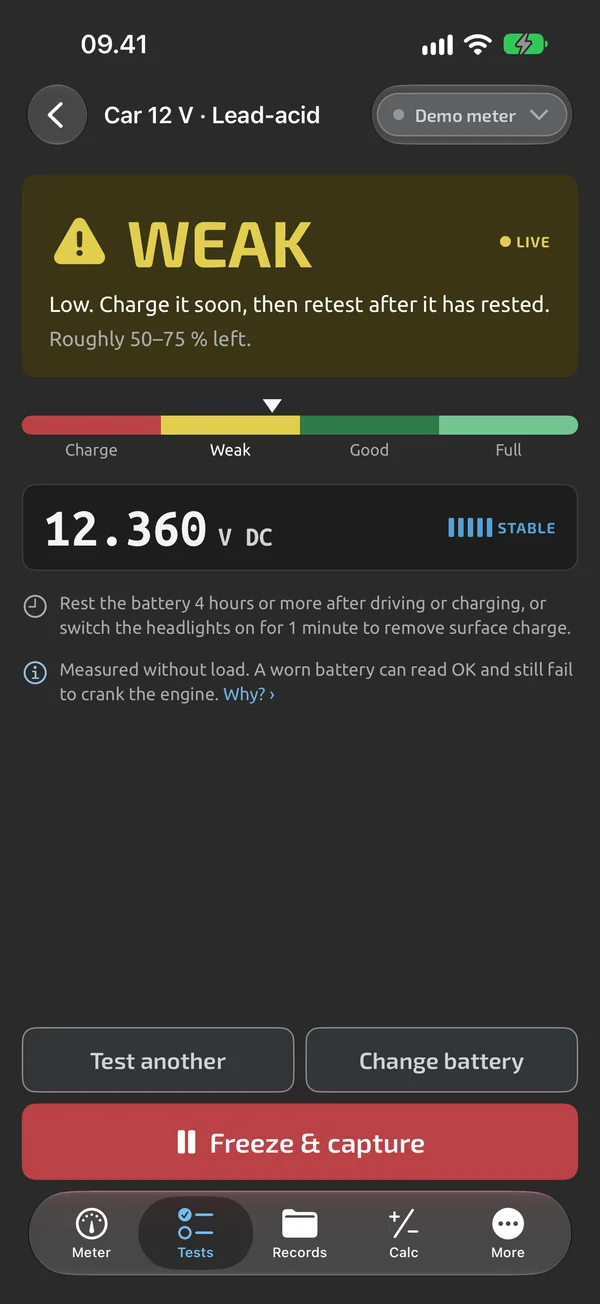
The app you can install today already helps with the manual method. It shows the meter's reading large on your phone, with the settled digits brighter and five stability bars that light when the reading is steady, so you can watch the probes instead of the meter. One tap saves the reading, and you can add a label and a note, such as which device the battery came from.
Where the numbers come from
The bands come from battery makers' datasheets and handbooks (Energizer, Duracell, Renata, Optima), Battery University and common battery testers. They are the bands the app uses. Charts marked indicative have fewer sources or a flat curve: lithium AA and AAA, silver oxide, zinc-air, LiFePO4 and the 6 V lantern battery.
What the app does here, and what it doesn't
| What it does | Plan |
|---|---|
| Pick the battery type and see FULL, GOOD, WEAK or the end of its life from the DC volts, with the next step. | Free Coming |
| A large readout that shows which digits have settled; OL and UL are shown as OL and UL, never as a number. | Free |
| Five stability bars show when a reading is steady. | Free |
| One tap saves the current reading, with an Undo. | Free |
| Add a text note and a short label to any capture. | Free |
Not yet, or not planned
- No load test: the battery tester reads the voltage without load, so it cannot show a car battery's cranking strength.
- Reads what your meter measures; it doesn't change the meter's accuracy or ranges.
Questions
How do I know if my battery is bad with a multimeter?
Measure its resting voltage on DC volts and compare it with the chart for its chemistry. A reading in the lowest band means the battery is empty: replace it, or recharge it if it is rechargeable. A battery that reads GOOD but fails in the device is worn: its voltage drops under load, which a resting reading does not show.
How do I check if my battery is ok?
Take it out of the device, wait a minute, and measure it with red on plus and black on minus. An alkaline AA, AAA, C or D cell is GOOD from 1.45 V and FULL from 1.55 V. Other chemistries have other values, so use the chart for your battery or the battery checker.
How can you tell if a battery is completely dead?
It reads close to zero volts. A reading under one fifth of the battery's nominal voltage counts as no battery at all, for example under 0.3 V on a 1.5 V cell. First check that both probes touch bare metal. A protected Li-ion cell can also read 0 V when its protection has tripped.
How do I convert battery voltage to percentage?
Only roughly, and only for chemistries whose voltage falls steadily. A flooded 12 V car battery at rest is about 100 % charged at 12.60 V, about 75 % at 12.40 V and about 50 % at 12.20 V. Alkaline cells also fall steadily, so their bands track the remaining charge. Lithium AA, coin cells, NiMH and LiFePO4 stay almost flat until the end, so a percentage from their voltage would mislead.
Try it in the demo
A simulation of the app in your browser, with made-up readings: no meter and no install needed.
Get TestNMeasure for iPhone and iPad.
iPhone and iPad (iOS 17 or later): free on the App Store. Android later.


Questions or a meter to suggest? Mail support@testnmeasure.app.
No ad networks, no sign-up.