Guide · updated 3 November 2026 Free Pro
Bonding Resistance Check Explained: What a Multimeter Can and Can't Do
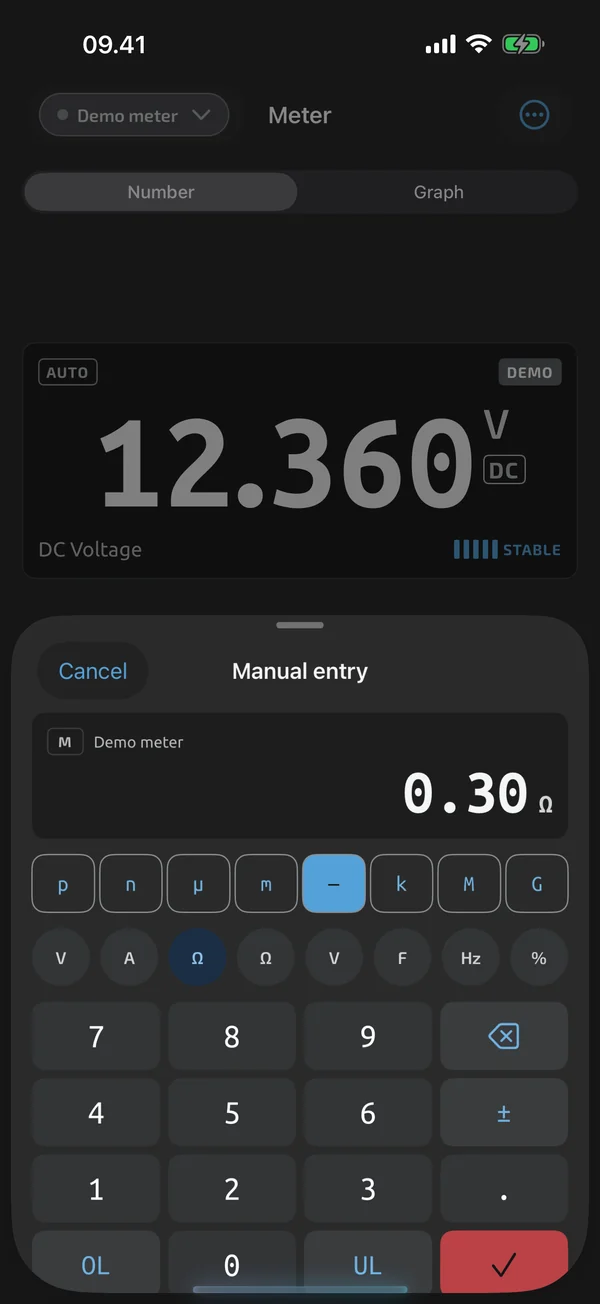
A bonding check measures the resistance of a path between two metal parts, such as an equipment frame and the airframe. The limits are small: a few thousandths of an ohm. A handheld multimeter cannot verify numbers that small, so the honest setup is two instruments. A bond tester reads the milliohm values and you type them in. The multimeter, with its leads zeroed, covers the bonds whose limit is 1 Ω. TestNMeasure keeps both kinds of value in one record.
This guide covers a general bonding check. The aircraft or component maintenance manual wins over everything here, and a test file is your record, not a certification.
iOS and Android, beta this winter.
Bond tester or multimeter
A bond tester is built for low resistance. Most use four-wire leads, so the lead resistance drops out of the result, and they show thousandths of an ohm. AC 43.13-1B recommends bond testers for this work (para 11-188 i).
A handheld multimeter has two problems at this scale:
- Resolution. A limit of 0.0025 Ω needs a resolution of 0.0001 Ω or better. A handheld meter cannot verify a limit this small. Your meter's data sheet gives its resolution on the lowest ohms range.
- Lead resistance. Two test leads add resistance of their own. With the leads shorted, press REL to subtract it. This helps, but it does not turn a handheld meter into a bond tester.
So use a multimeter for the 1 Ω class of bonds, and a bond tester for the rest. The app reads what your meter measures and does not change its accuracy.
Example limits
These values are read from the public FAA advisory circular AC 43.13-1B. The circular is guidance, not a regulation. Each value is example; set your own limits, and your maintenance manual wins.
| What is checked | Example limit | Paragraph | Instrument |
|---|---|---|---|
| Frame of electrical equipment to structure | less than 2.5 mΩ | AC 43.13-1B para 11-188 f | Bond tester |
| Each connection of a bonding jumper | at most 0.003 Ω | AC 43.13-1B para 11-189 | Bond tester |
| Electric-shock bond of conduit or equipment | 0.01 Ω or less | AC 43.13-1B para 11-192 | Bond tester |
| Static bond of a larger isolated part | less than 1 Ω, clean and dry | AC 43.13-1B para 11-187 c | Multimeter with REL |
| Small metal items in a fuel tank, fuel-line items | 1 Ω or less | AC 43.13-1B para 11-191 | Multimeter with REL |
Measure after the mechanical connections are complete (para 11-188 j). Paragraph 11-188 f also tells you to refer to the manufacturer's instructions.
Record bond-tester values
- Add a step for each bond to a template. Use the template builder Pro, or follow the table below on paper.
- Set the step's limit with the unit ohm and the milli prefix, for example a maximum of 2.5 mΩ Pro.
- When you run the check, read the bond tester and type the value into the step.
- The step shows PASS or FAIL against your limit Pro.
- Typed values are marked manual in the reports, so a reader can tell a typed value from one the meter sent.
The step for the instrument itself is a typed value too: its name or ID. Add a run field for it, so the record names the bond tester next to the multimeter. The PDF report shows each value with its unit, limit and result.
An example step table
This table is an example you can build with the template builder. It is not an included starter template.
| # | Step | Kind | Entry | Example limit |
|---|---|---|---|---|
| 1 | Instrument used and its ID | value | typed | none |
| 2 | Equipment frame to structure, per item | measure, mΩ | typed | max 2.5 mΩ (11-188 f) |
| 3 | Bonding jumper, per connection | measure, mΩ | typed | max 3 mΩ (11-189) |
| 4 | Shock bond, conduit or equipment | measure, mΩ | typed | max 10 mΩ (11-192) |
| 5 | Static bond, larger isolated part | measure, Ω | meter, leads zeroed with REL | max 1 Ω (11-187 c) |
| 6 | Fuel system items | measure, Ω | meter, leads zeroed with REL | max 1 Ω (11-191) |
| 7 | Bond secure, no corrosion, jumper free of moving parts | check | Pass, Fail or N/A | none |
| 8 | Measured after mechanical connections were complete | check | Pass, Fail or N/A | none |
Limits in the app are inclusive: a maximum of 1 Ω passes at exactly 1 Ω. The circular says "less than 1 ohm", so if you want to match it, enter 0.999 Ω as your maximum Pro.
What the app does here, and what it doesn't
| What it does | Plan |
|---|---|
| Type the reading from any instrument; typed values are marked as manual. | Free |
| Type a value, or give a Pass, Fail or N/A verdict, when a step needs it. | Free |
| REL shows the difference from a stored reference, for example to null out test-lead resistance. | Free |
| Build test templates with steps, groups, limits and run metadata fields. | Pro |
| Set limits per step: range, min, max, equals, tolerance or expected open. Bounds are inclusive. | Pro |
| Start a run with a title and your own metadata fields, such as a serial number that counts up. | Free |
| A PDF test report with header, result, step table, notes, photos and a signature block. | Free |
Pro is a one-time purchase and Cloud is a subscription, both in the app. See what is Free, Pro and Cloud.
Not yet, or not planned
- A test file is your record, not a certification.
- Starter templates are examples (beta-v1, revisable); you set the limits for your equipment.
- Typed values are marked "manual" in reports.
Questions
Can my multimeter check a 2.5 mΩ bond?
No. A handheld multimeter does not resolve milliohms, and its leads add more resistance than the limit allows. Use a bond tester and type the value into the step.
Does the app read my bond tester?
No. Bond testers are entered by hand: you type the value, and the report marks it manual. There is no Bluetooth link to a bond tester.
Where do the limits come from?
The values in this guide are examples from the public advisory circular AC 43.13-1B, each with its paragraph. You set the limits in your template from your own manual.
Coming to iPhone and Android.
iOS and Android, beta this winter.


Questions or a meter to suggest? Mail support@testnmeasure.app.
No ad networks, no sign-up.