Guide · updated 12 November 2026
How to test a car battery with a multimeter
A resting voltage tells you how charged a car battery is. Whether it can still start the engine, and whether the car charges it, takes three more readings. All four need only a multimeter and about ten minutes. Do them in this order, because each one rules out a cause.
iPhone and iPad (iOS 17 or later): free on the App Store. Android later.
What you need
- A multimeter with DC volts and AC volts. A MIN or MIN/MAX key helps for the cranking check.
- Test leads with clips, or a helper to turn the key.
- A battery that has rested: 4 hours with the engine off, or 1 minute with the headlights on and then off.
Keep hands, leads and loose clothing away from the fan and the belts. Clip the leads on before you start the engine, and do not hold the probes while cranking. A lead-acid battery can give off gas that burns: no sparks or flames near it, and connect and remove the leads with the engine off. Never put the meter on a current (A) range across the battery, and keep metal tools away from the two terminals.
Check 1: resting voltage
Engine off, lights and every other load off. Set the meter to DC volts, touch red to the plus post and black to the minus post, and read the voltage at rest with two decimals.
| Verdict | Car battery 12 V (flooded) | 12 V AGM |
|---|---|---|
| FULL | 12.60 and up | 12.80 and up |
| GOOD | 12.40 to 12.60 | 12.50 to 12.80 |
| WEAK | 12.20 to 12.40 | 12.20 to 12.50 |
| Below Weak | 12.00 to 12.20CHARGE & RETEST | 12.00 to 12.20CHARGE & RETEST |
| Lower still | under 12.00REPLACE | under 12.00REPLACE |
Measured at rest, with nothing connected. A reading exactly on a boundary counts as the higher band.
A reading above 12.70 V on a flooded battery, or above 13.00 V on an AGM battery, is surface charge, not a resting voltage: switch the headlights on for 1 minute, then off, and measure again, or let the battery rest 4 hours. Do not correct the resting voltage for temperature: the temperature figures you may find for lead-acid are for the charging voltage.
If the battery is under 12.20 V, charge it fully and let it rest before you go on. The cranking limit of check 2 is for a charged battery, so a flat battery fails it whether it is healthy or not. What each resting value means is in the car battery voltage chart.
Check 2: voltage while cranking
This is the load test a multimeter can do: the starter is the load.
- Clip the probes to the battery posts and set the meter to DC volts.
- Press the meter's MIN key, so that it keeps the lowest reading.
- Crank the engine and watch the reading while the starter turns. Crank for 10 seconds at most, with a pause between tries.
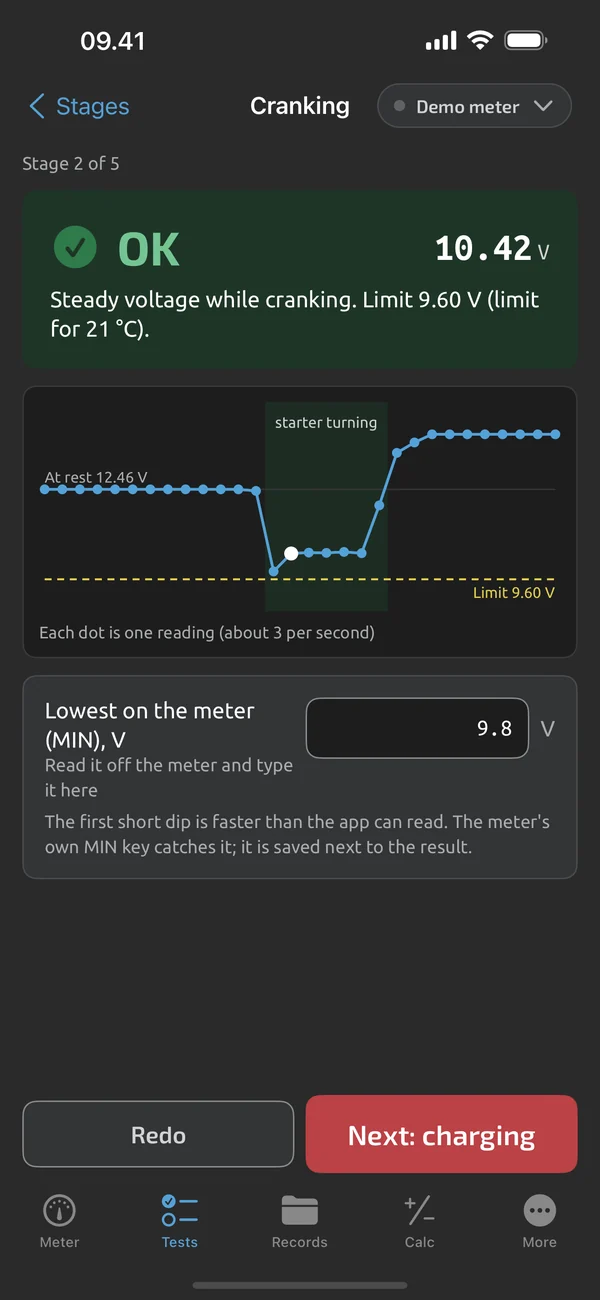
- Read the steady voltage while cranking, and the MIN value afterwards.
A charged, healthy battery holds 9.6 V or more while the starter turns, at about 21 °C. A cold battery may go lower:
| Battery temperature | Lowest steady voltage while cranking |
|---|---|
| 21 °C or warmer | 9.6 V |
| 16 °C | 9.5 V |
| 10 °C | 9.4 V |
| 4 °C | 9.3 V |
| −1 °C | 9.1 V |
| −7 °C | 8.9 V |
| −12 °C | 8.7 V |
| −18 °C and colder | 8.5 V |
The limit at 21 °C is the classic load-test figure. The colder rows are indicative: treat them as a guide. Between two rows, use the colder one: a battery at 13 °C uses the 10 °C row. The limit is for the steady voltage, not for the very short first dip when the starter engages. A multimeter updates a few times per second, so it shows the steady value well and the first dip poorly.
Check 3: charging voltage
Start the engine and hold it at about 2000 rpm. Measure across the battery posts on DC volts, first with the loads off, then again with the headlights and the blower on.
- 13.8 to 14.7 V: the usual band. The car charges the battery.
- Close to the resting voltage: no charge is arriving. Check the belt, the wiring and the alternator.
The band is the usual workshop figure, and it is indicative: sources differ on whether the loads should be on or off. Many newer cars control the alternator from the engine computer (a smart alternator). It can sit lower when the battery is full and go higher when the car brakes, so on such a car a reading outside the usual band can be normal. Judge it over several minutes, not at a glance.
Check 4: alternator ripple
With the engine still at about 2000 rpm and the loads on, switch the meter to AC volts and measure across the battery posts again. The reading is the ripple the alternator leaves on the DC voltage.
- Under 0.05 V AC: OK.
- From 0.05 V up to 0.30 V AC: borderline. Check the connections and measure again.
- 0.30 V AC or more: ripple this high suggests a faulty diode or stator. Have the alternator checked.
The borderline stretch and the 0.30 V fault limit are indicative. Many multimeters measure a small AC voltage on top of a DC voltage poorly, so measure twice before you blame the alternator.
Optional: voltage drop in the cables
If the battery passes and the starter still turns slowly, the loss may be in a cable or a clamp. Measure on DC volts while cranking:
- From the battery's minus post to the engine block: 0.2 V or less.
- From the battery's plus post to the starter's terminal: 0.5 V or less in total, and 0.2 V or less across any single connection.
Reading the four results
| Rest | Cranking | Charging and ripple | What it points to |
|---|---|---|---|
| WEAK or CHARGE & RETEST | not tested, or under the limit | not tested | A discharged battery. Charge it and test again. |
| REPLACE | not tested | not tested | Deeply discharged. Charge it fully and let it rest: still under 12.00 V, replace it. |
| FULL or GOOD | Under the limit | any | Charged, but it collapses under the starter: a worn battery. Replace it. |
| FULL or GOOD | Good | Outside the usual band | A charging problem, or a smart alternator at work. Not the battery. |
| FULL or GOOD | Good | Ripple 0.30 V AC or more | A faulty alternator diode or stator. |
| FULL or GOOD | Good, but the starter turns slowly | Normal | A bad cable or clamp: do the voltage drop check. |
| FULL or GOOD | Good | Normal, but flat again after some days | Something drains the battery while the car is parked. |
In the app
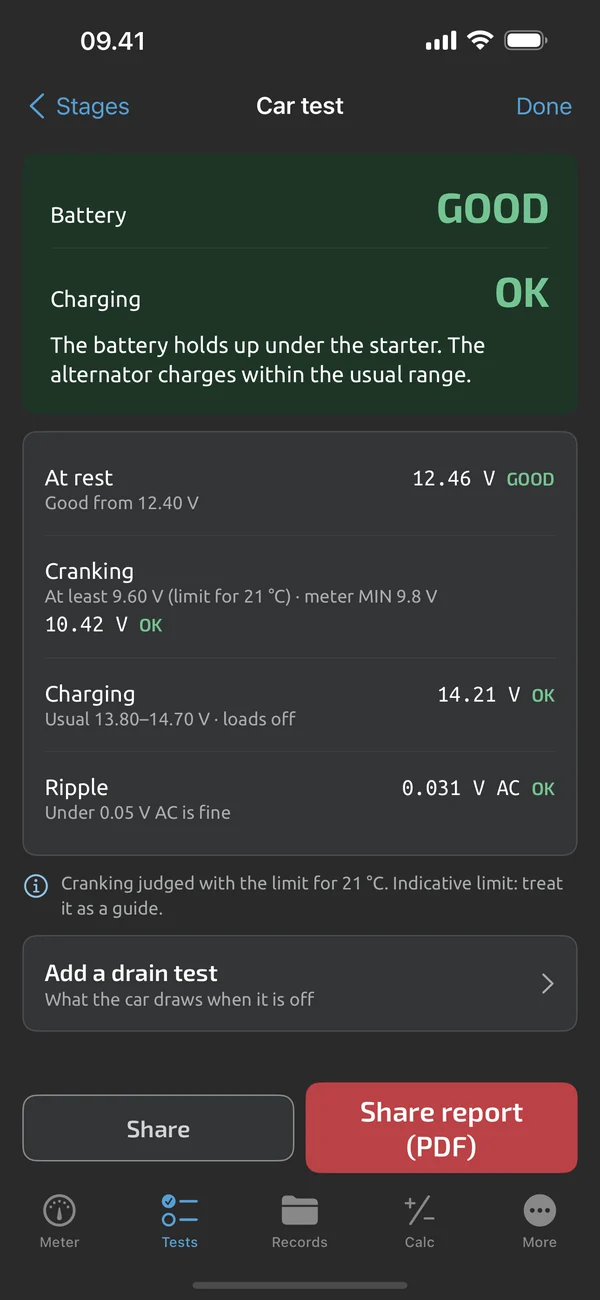
The car battery & charging test in TestNMeasure walks you through the four checks of this page, in the same order, with a Bluetooth multimeter on the battery posts. You pick Flooded or AGM and the system (12 V; 24 V and 6 V use the same limits, scaled), and you may type the vehicle and the battery temperature. The safety lines are on the screen from the set-up on.
- At rest: the battery tester's verdict, FULL, GOOD, WEAK, CHARGE & RETEST or REPLACE, with "About … % charged". A reading that is too high gets the surface-charge step.
- Cranking: "Press MIN on the meter, then tap Crank now", then start the engine. Each reading appears as a dot, about 3 per second, against the resting voltage and the limit line. The app judges the steady voltage while cranking (the lowest voltage that held for two readings in a row) against the limit for your temperature, or the limit for 21 °C when you typed none. Then you type the meter's MIN, which is saved next to the result. The app never says it caught the first dip.
- Charging and Charging with loads on: OK, LOW or HIGH against the usual band. Outside it the app says that on a car with a smart alternator this can be normal; it never says the alternator is faulty.
- Ripple: on AC volts, OK, BORDERLINE or FAULT.
You can skip a stage. The summary has a Battery line and a Charging line, each in words and in colour, and "Share report (PDF)" makes a one-page report with each stage's reading, the limit that applied and the verdict. The stages are saved to Records as one result, so the battery history shows the car test next to earlier ones, and "Test again" compares two results. "Add a drain test" at the end goes on to the parasitic drain test, for a battery that goes flat while the car is parked. More: Battery tester.
The app does not do the voltage drop check, and it does not cover lithium starter batteries.
Where the numbers come from
The resting bands follow Battery University (BU-903) and battery makers' charts, and they are the bands the app uses. The 9.6 V cranking limit is the classic load-test figure; the colder rows come from the usual load-tester chart. The charging band is the usual workshop figure. The ripple and voltage drop values follow meter makers' application notes for alternators and starter circuits. Values marked indicative rest on a single source, or the sources disagree, and they are on our list to check on a real car.
What the app does here, and what it doesn't
| What it does | Plan |
|---|---|
| A guided test of a 12 V starter battery and its charging system: rest, cranking, charging and ripple, with a one-page report. | Free |
| Pick the battery type and see FULL, GOOD, WEAK or the end of its life from the DC volts, with the next step. | Free |
| Every battery result is kept with the battery, the date and the verdict, so you can see what was tested and how it changed. | Free |
| Log the current a switched-off car draws while its control units fall asleep, against the 50 mA line. | Free |
| A PDF test report with header, result, step table, notes, photos and a signature block. | Free |
Not yet, or not planned
- Meter-side MIN/MAX modes show as flags only.
- Reads what your meter measures; it doesn't change the meter's accuracy or ranges.
Questions
How to tell if a 12-volt battery is bad?
Charge it fully, let it rest, and measure it. If it rests under 12.00 V after a full charge, it is finished. If it rests well but falls under 9.6 V while the starter turns at about 21 °C, it is worn. If both readings are good, look at the charging system and at what drains the battery while the car is parked.
What voltage is considered low for a 12V battery?
At rest, under 12.20 V a flooded battery is less than half charged and needs charging. Under 12.00 V it is deeply discharged.
Can a multimeter load test a car battery?
Not by itself: it draws almost no current. The starter can be the load. The steady voltage while cranking, read with the meter's MIN function as a check, is the multimeter version of a load test.
Try it in the demo
A simulation of the app in your browser, with made-up readings: no meter and no install needed.
Get TestNMeasure for iPhone and iPad.
iPhone and iPad (iOS 17 or later): free on the App Store. Android later.


Questions or a meter to suggest? Mail support@testnmeasure.app.
No ad networks, no sign-up.